Top Signs You Need Garage Door Service – Don’t Ignore These
A garage door that takes two seconds longer to open than it did last year has already told you something is wrong. The problem is that two seconds doesn’t feel like a warning sign until a cable snaps on a Tuesday morning with the car trapped inside. The signs of a door heading toward failure are rarely subtle. Homeowners simply normalize them, because the door keeps working, right up until the day it doesn’t. If you’d rather not climb a ladder and start poking at tensioned steel yourself, call us at (866) 819-6714 and we’ll take a look.
Below are the signals we look for first, ranked roughly by how much trouble they tend to precede. Most of what we describe here you can check yourself in a few minutes. Knowing what to watch for is the difference between a quick repair and a door that has to come down entirely.
What are the first signs you need garage door repair?
The earliest sign is usually a change in sound, speed, or movement that you notice before the door actually fails. A door that hesitates, groans, or drifts to one side is telling you a component is wearing out. Catching it now means a targeted fix. Ignoring it means more parts wear together until the door stops entirely. For Fall River homeowners, the most common early warnings fall into four categories: unusual noise, uneven travel, opener behavior that has shifted, and visible wear at the cables, rollers, and hinges.
Think of your door as a system of springs, cables, drums, rollers, and an opener all working in balance. When one part starts to fail, the others pick up the slack. That’s why a small problem snowballs. A worn roller drags, the motor works harder, the spring wears faster, and six months later you’re replacing more than you would have. A routine garage door repair visit catches these early. A failure caught late is a bigger job on a worse timeline.
The asymmetry test: does your door move unevenly?
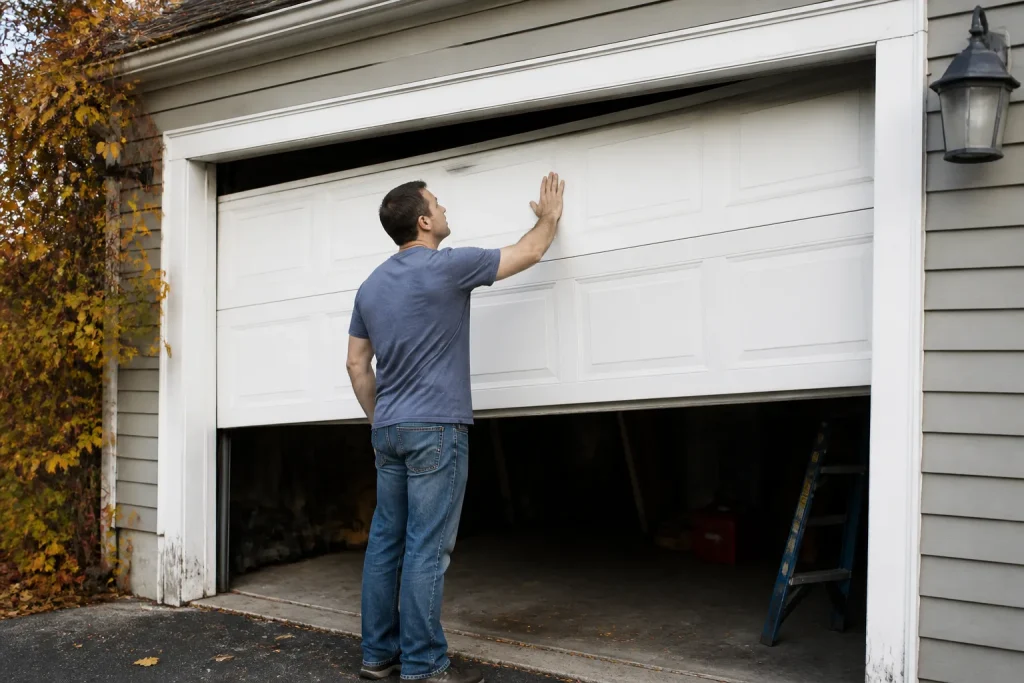
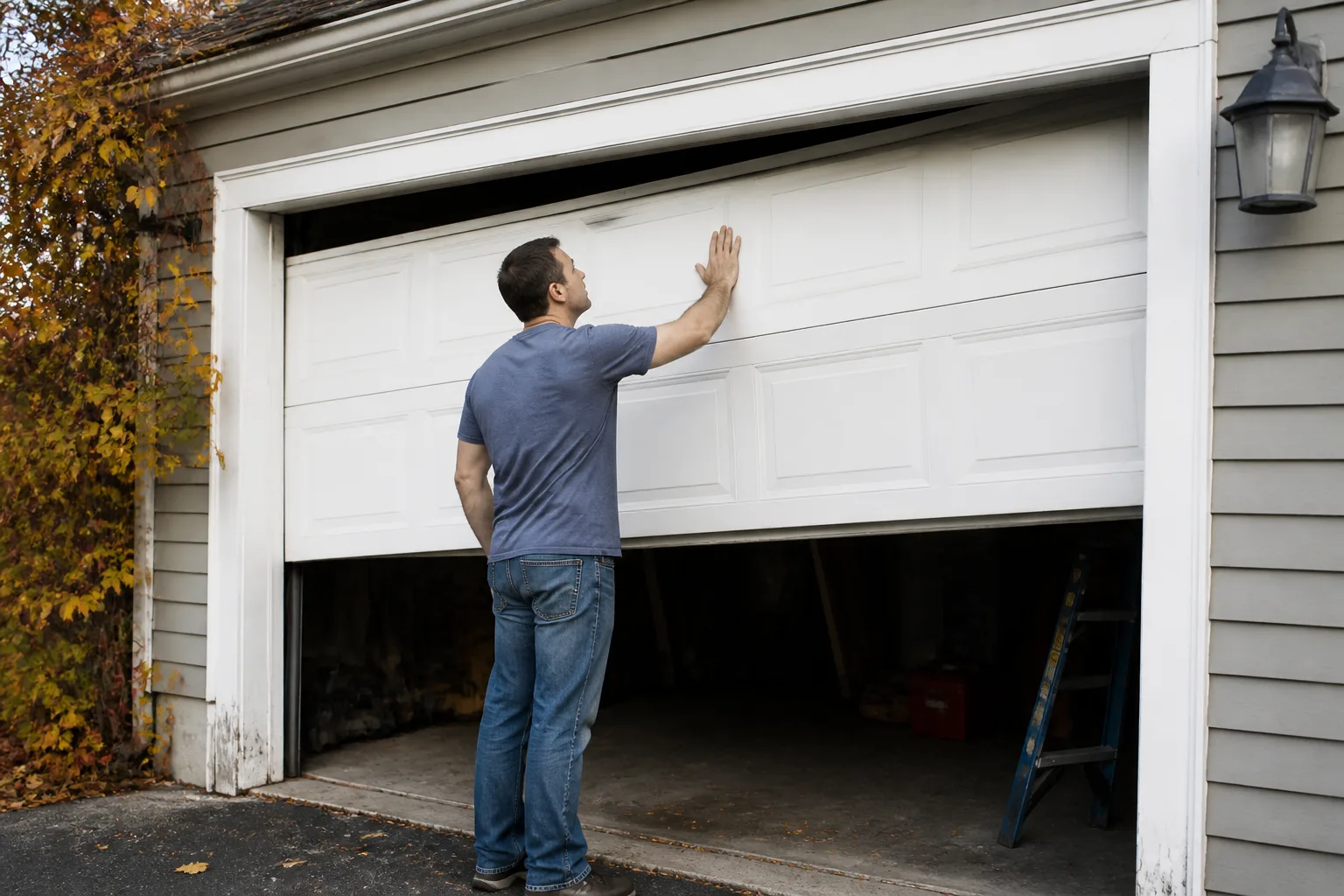
Watch your door travel from fully closed to fully open. If one side lags behind the other, or the bottom edge tilts rather than staying level, that’s an uneven movement signaling cable tension imbalance. This matters because a door that moves unevenly is loading the cables and drums at different rates than they were designed for. Over time, that imbalance leads to a cable jumping off its drum, a frayed cable, or drum damage.
You may also notice the door pulling slightly to one side, or a rubbing sound on the track that wasn’t there before. Those are the same imbalance showing up in different places. On a Clopay or Amarr sectional door, an uneven bottom edge also stresses the panels, and panel replacement is a more expensive conversation than a cable adjustment.
Cables carry the full weight of the door under serious tension. If you see a slack cable, a cable off its drum, or a visibly frayed strand, stop operating the door and don’t touch the cable yourself. Cables and springs are the two parts of a garage door that cause the most serious injuries to people trying to fix them at home. This is a job for trained hands and proper tools.
What do the different noises actually mean?
Every noise has a mechanical cause, and some matter more than others. Here’s how we sort them:
- Grinding: Usually a roller that has seized or a bearing that’s dried out. Metal is grinding against metal instead of rolling. Fixable, but it wears the track as it goes. Get it checked before the track itself needs work.
- Rattling: Loose hardware. Hinges, bolts, or track brackets working their way loose. Usually the mildest of the bunch, but rattling can also be a sign the door has shifted in its frame, so it’s worth a look.
- Popping or snapping: This one is urgent. Popping during travel often points to a spring or cable under stress, sometimes the beginning of a torsion spring giving way. Stop using the door and have it inspected. A spring that breaks while the door is in motion is dangerous.
- Squealing: Dry rollers, a worn opener bearing, or a torsion tube that needs attention. Not usually an emergency, but squealing that gets louder over a few weeks is a component on its way out.
In Fall River and the surrounding towns, humidity and temperature swings work rollers and hinges harder than most homeowners realize, so noise tends to show up gradually. If a noise is new, that’s your cue. If it’s been there a while and getting worse, that’s your deadline.
The opener behavior tells
A lot of problems homeowners blame on the opener are really hardware problems underneath. The motor is just the messenger. Watch for these behaviors, which point to specific faults rather than simply old age:
- Motor runs longer than usual: The door is getting heavier to lift, which usually means a spring losing tension or a binding track. The opener is straining to compensate, which shortens its life too.
- Door reverses unexpectedly: Often a travel limit or force setting that’s out of adjustment, or an obstruction the safety sensors are catching. Sometimes it’s a sign the door has started to bind and the opener is sensing resistance.
- Hesitates before moving: A pause before the door starts to travel can point to a failing capacitor in the opener, or a wall control or sensor issue.
- Remote or keypad works intermittently: Usually a signal or logic board matter, and typically a straightforward fix for a technician who knows the Genie or Wayne Dalton system in question.
Because we work on Genie, Clopay, Amarr, Wayne Dalton, and the other major opener and door brands, we can read these symptoms against the specific system in your garage instead of guessing. That’s garage door opener repair done with the right parts the first time, without voiding the manufacturer’s warranty.
A five-minute visual inspection you can do yourself
You don’t need tools for most of this. Before you start, close the door, watch for anything under tension, and don’t reach for the cables or springs. Here’s what a homeowner can safely check:
- Cable fraying at the drum: With the door closed, look at the cables running along the sides near the bottom rollers. A cable with frayed strands, a kink, or one that’s sitting slack is a stop-using-the-door situation.
- Roller wear pattern: Rollers should ride freely in the track. Flat spots, a wobble, or a roller that no longer turns means metal-on-metal wear is starting.
- Hinge stress cracks: Look at the hinges connecting the panels. A hairline crack or a hinge that’s bent out of shape means the door is being stressed.
- Weatherstripping seal failure: The rubber along the bottom should touch the floor evenly with no light showing through. Gaps let water and cold air in, and they tell you the door isn’t seating level.
Anything you see here that looks off, especially cable fraying, is worth a call. Spring and cable work is garage door spring repair territory, and it isn’t a five-minute DIY job. Our technicians have up to 11 years of experience with this exact work.
Why intermittent problems are more dangerous than constant ones
A door that sometimes works fine is masking a failure that will eventually choose the worst possible moment. A consistently broken door you stop using and call about. A door that works on Monday, sticks on Tuesday, and works all week after that teaches you to ignore it. Then it fails on the morning of a school run, or a storm, or the day you’re loading for a trip.
Intermittent failures usually point to something shifting under load: a cable starting to fray, a spring losing the last of its tension, a limit switch drifting. The symptoms come and go because the problem hasn’t fully let go yet. In our experience in Fall River, these are the failures people describe as “it just happened.” It didn’t. It was building for months, and the door was quietly telling them.
When to call a pro
Call a professional if you see any of these: a door that moves unevenly, popping or snapping during travel, a cable that looks frayed or slack, a door that reverses on its own, or anything involving the springs. Our garage door repair line handles these directly, and if a door won’t close, we offer emergency garage door service, because a door stuck open is a real security and safety risk, not just an inconvenience.
Related services in Fall River: opener diagnostics and repair, spring repair and replacement, and complete new door installation when a door has reached the end of its useful life.
The Bottom Line
The signs that your garage door needs service are rarely dramatic at first. Uneven movement, a new noise, an opener that drags or hesitates, a frayed cable, or a problem that comes and goes are all early warnings. Catching them early turns a small repair into a small repair. Ignoring them turns it into a failed door, a bigger fix, and a bad morning. We can tell you exactly what’s going on, and the written estimate sets the price before any work starts.
If you’re in Fall River and need help, Fall River Garage Door Repair Co offers free estimates. Call (866) 819-6714 and we’ll get your door back in shape. You’ll find Fall River Garage Door Repair Co and the full range of what we handle right here.
Frequently Asked Questions
If the door moves smoothly but squeaks or rattles, it’s usually maintenance: lubrication, tightening hardware, or replacing worn rollers. If the door moves unevenly, a cable looks frayed, the door pops or snaps, or the opener reverses unexpectedly, that’s a repair and worth a professional look. Call (866) 819-6714 for an exact quote on either.
You can safely look at the cables and note fraying, kinks, or slack, and you can see whether the springs look worn. What you should not do is touch, adjust, or replace them. Cables and springs carry the full weight of the door under serious tension and are the leading cause of garage door injuries. Leave the work to trained technicians. Call (866) 819-6714 and we’ll handle it.
Yes. Intermittent problems are often more dangerous than constant ones, because they mask a failure that’s building. A door that sticks one day and works the next usually has a component starting to fail under load. Have it checked before it picks the worst possible moment to stop working. Call (866) 819-6714 for a free estimate.
We service eight of the most widely installed garage door and opener brands: LiftMaster, Chamberlain, Genie, Clopay, Amarr, Wayne Dalton, Craftsman, and Raynor. Being familiar with both the door hardware and the opener system means a faster diagnosis and the correct parts the first time. Call (866) 819-6714 to talk through your specific system.
Written by the team at Fall River Garage Door Repair Co.
Need Garage Door Help?
Call Fall River Garage Door Repair Co - the local pro we connect you with is licensed and insured, here with fast after-hours help in Fall River.
(866) 819-6714